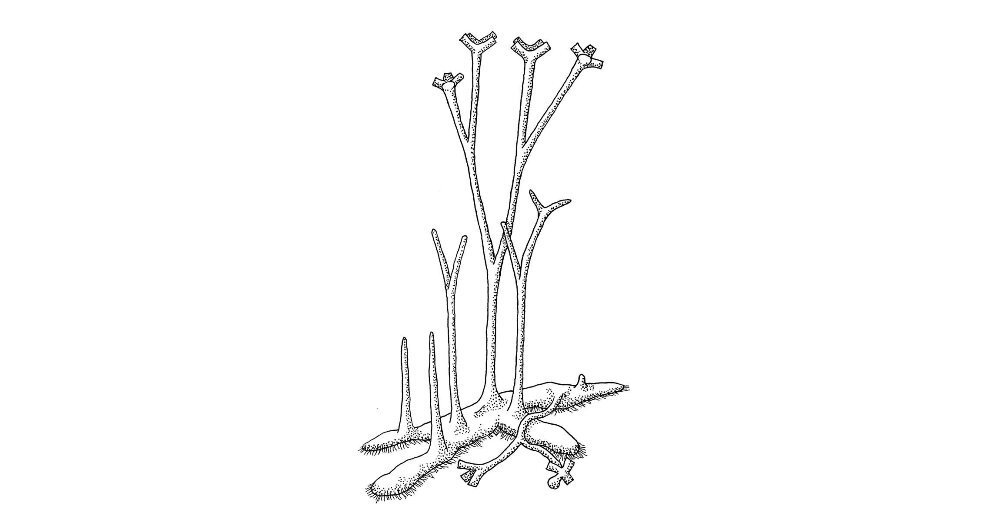

Scientists from Natural History Museum London studied the fossils of an ancient plant Horneophyton lignieriwhose age is 407 million years. Work helps to understand how plant vascular systems evolved to allow last grow to enormous sizes. The results of the study were published in the magazine New Phytologist .
Nthis onetune evolutionary1st stage
Horneophyton lignieridiscoveredcry V beginning XX century in Scotland, has long been a mystery to scientists. At first was consideredthat this plant had a normal vascular system, including xylem and phloem, like modern plants.
Фото: Natural History Museum, London
Horneophyton
However, with the use of modern technology, scientists have been able to study fossils in 3D and discover that Horneophyton possessl unique fabric for transporting water and nutrients thatit can be considered an earlier stage of evolution.
TOsilem and phloem are the two main tissues of the plant vascular system, which are responsible for transporting substances throughout the plant. Xylem is the tissue that carries water and minerals from the roots to the rest of the plant, especially the leaves. Xylem consists of dead cells that form tubes that conduct water. It allows the plant to grow to great heights by delivering water to its upper parts. Phloem is a tissue that transports the products of photosynthesis For example, sugars, from the leaves (where they are produced) to other parts of the plant. Phloem is made up of living cells that can transport nutrients up and down the plant.
Unlike modern plants, Horneophyton moved water and sugars simultaneously, its vascular system was not yet divided into two types of cells.
Research shows that the phloem-like cell came first and the xylem came later. Thiso workedo only for small plants such as Horneophytonwho was height up to 20 cm. Nevertheless, this was an important step towards evolution V largeris grown upI.
Фото: Natural History Museum, London
Asteroxylon
The appearance of tall trees
Soon after the appearance Horneophytonhis contemporary Asteroxylon developed a more advanced vascular system with separate xylem and phloem. This allowed him to grow twice as big as Horneophytonand create the preconditions for the further growth of trees and ferns. Gradually, the evolution of vascular systems led to emergence giganticand grown upand.
This study becomes key to understand how plants evolved and changed the planet.
Disclaimer: This news article has been republished exactly as it appeared on its original source, without any modification. We do not take any responsibility for its content, which remains solely the responsibility of the original publisher.
Author:
Published on: 2025-12-21 12:02:00
Source: naukatv.ru